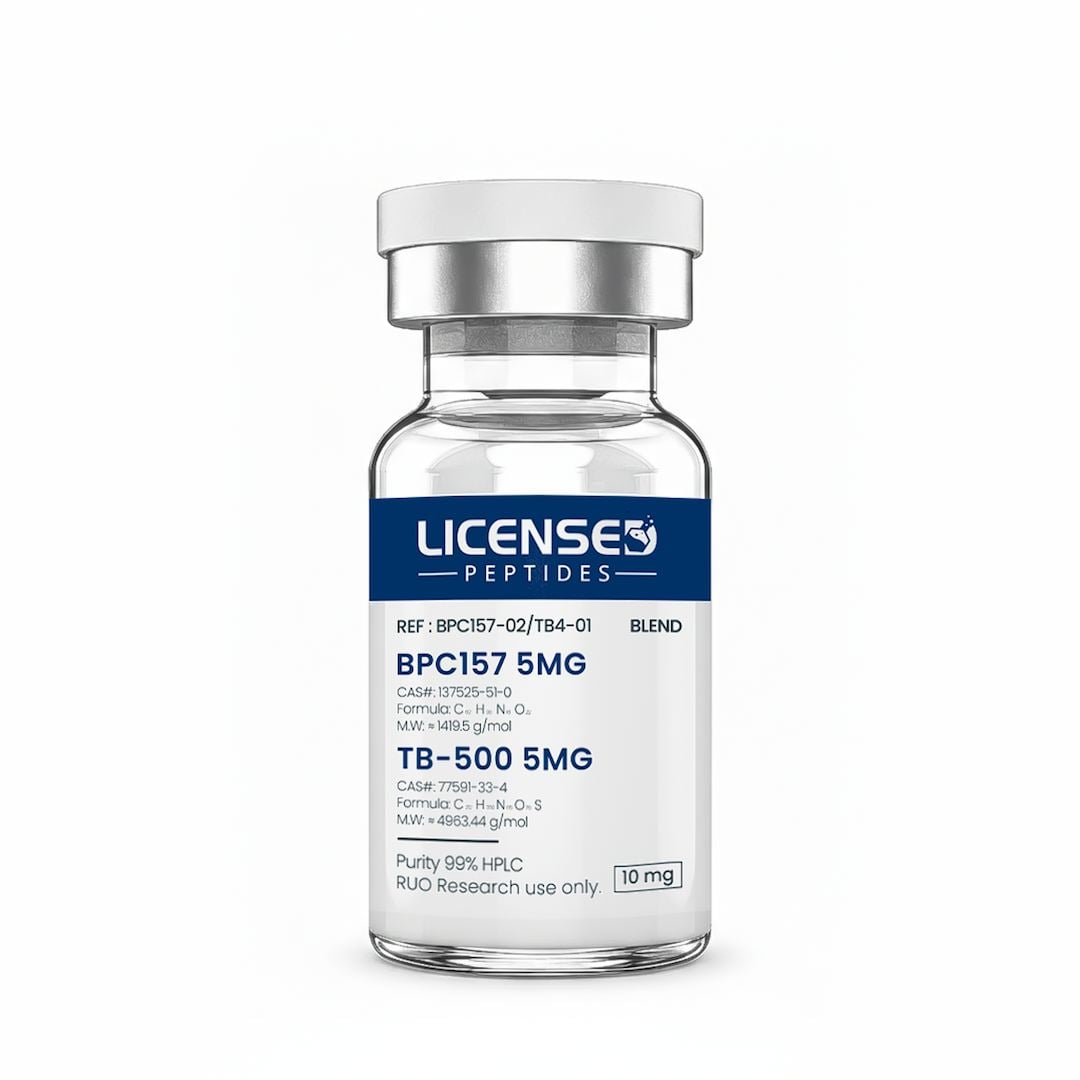

BPC-157 5mg, TB-500 5mg Wolverine Blend (10 Vials)
Bulk pack of 10 vials of the popular Wolverine Blend combining BPC-157 and TB-500.
US cGMP Manufactured
Synthesized & lyophilized in our US production lab.
COA on Every Lot
HPLC + Mass Spec verification shipped with each order.
Insured Worldwide Shipping
Reship guarantee on lost or seized parcels.
For laboratory research use only. Not for human or veterinary use.
About BPC-157 5mg, TB-500 5mg Wolverine Blend (10 Vials)
Overview
This blend is a laboratory research material used to examine how two peptides may interact with cellular signaling systems and structural pathway responses in controlled experimental models. References to biological effects are provided for scientific context only and must not be interpreted as claims of therapeutic, diagnostic, cosmetic, or clinical benefit. This product is not offered for human or veterinary use.
Dual-Peptide System for Cellular Signaling and Structural Pathway Studies
BPC-157 and TB-500 are research peptides used to study distinct but potentially complementary signaling pathways in laboratory models. BPC-157 is used in research to examine localized peptide signaling and cellular-response behavior, while TB-500 is used to study actin-related and structural pathway responses. Any references to tissues, cells, or pathways are provided for research context only and do not imply therapeutic or clinical use.
Purpose of the Blend in Research Settings
In laboratory and educational research, peptide blends are often used to explore complex biological responses that involve more than one pathway. This blend is designed specifically for that purpose: to support multi-pathway observation under controlled experimental conditions. Researchers may examine how localized cellular activity interacts with broader signaling or structural pathways. The material is intended for experimental use only and does not imply human or animal benefit.
Dual-Pathway Research Perspective
BPC-157 is frequently examined in laboratory settings for localized signaling behavior. TB-500 is commonly studied for broader structural and actin-related pathway responses. Researchers may compare these peptides in controlled experimental models to evaluate pathway activity, cellular movement, and assay readouts. All references to biological systems are provided for research context only and do not imply therapeutic use.
Key Research-Related Properties and Advantages
- Multi-Pathway Observation: Enables investigation into both localized and system-wide responses within a single study.
- Angiogenesis and Vascular Marker Analysis: TB-500 is widely referenced in studies examining markers related to blood vessel formation and vascular remodeling.
- Cellular Migration and Structural Protein Research: Useful for evaluating fibroblast behavior, actin dynamics, and extracellular matrix interaction.
- Cytoprotective Pathway Modeling: BPC-157 is frequently included in studies examining inflammatory balance and cellular resilience.
- Synergistic Research Potential: Combining two peptides allows for observation of overlapping biological pathways that may remain obscured in single-compound analysis.
- Efficiency in Experimental Design: One blended formulation reduces the need for multiple experimental compounds while expanding analytical depth.
Common Research Applications
The BPC-157 + TB-500 blend is commonly utilized in laboratory research involving:
- Tissue behavior modeling
- Simulated injury and recovery pathways
- Cellular migration studies
- Angiogenesis and vascular structure evaluation
- Gastrointestinal signaling research models
- Musculoskeletal interaction simulation
- Comparative studies of local versus systemic pathways
- Performance-stress and recovery-based experimental models
All research applications are conducted in controlled laboratory environments and are intended strictly for scientific investigation.
Product Integrity and Research Reliability
Licensed Peptides is dedicated to supplying high-quality research peptides intended solely for laboratory and educational use. All peptide blends are produced with strict quality control standards to ensure consistency, stability, and reliability for research purposes.
Products are prepared, packaged, and distributed within the United States, ensuring dependable fulfillment and professional handling. Each vial is securely packaged to maintain peptide integrity during transit and storage.
Ordering is streamlined through a secure online system that accepts major payment methods. Once processing is complete, research materials are carefully prepared and shipped promptly to support uninterrupted laboratory workflows.
Frequently Asked Questions – BPC-157 + TB-500 (Thymosin Beta-4) Blend
(For Research Use Only – Not for Human or Animal Consumption)
1. What is BPC-157 and TB-500 research blend?
This blend combines two research peptides into a single formulation. BPC-157 is studied for localized peptide signaling, while TB-500 is studied for actin-related and structural pathway behavior. Together, they allow for broader experimental observation.
2. Why do researchers study these peptides together?
Researchers often combine these compounds to evaluate how localized signaling pathways interact with system-wide cellular and structural responses under controlled laboratory conditions.
3. What types of biological pathways are commonly examined?
Studies frequently explore cellular signaling, actin and cytoskeletal organization, angiogenic markers, and stress-response pathways.
4. Is this blend intended for therapeutic or medical use?
No. This product is strictly intended for laboratory research and educational purposes only. It is not approved for human or animal consumption, diagnosis, treatment, or prevention of any condition.
5. Is TB-500 the same as Thymosin Beta-4?
TB-500 is a synthetic fragment designed to mimic functional regions of naturally occurring Thymosin Beta-4. It is used in research settings to study related biological pathways.
6. How does this blend support angiogenesis research?
TB-500 is commonly referenced in studies examining markers involved in blood vessel formation and vascular remodeling. When paired with BPC-157, researchers can assess how vascular signaling interacts with localized tissue environments.
7. Can this blend be used in chronic tissue-model studies?
Yes. In experimental research, the blend is often applied to long-term or slow-response tissue models to evaluate sustained signaling and cellular adaptation.
8. How soon are observable changes noted in research models?
Observation timelines vary depending on experimental design, cell type, and study conditions. Some models report measurable pathway changes within days, while others require longer observation periods.
9. Are BPC-157 and TB-500 considered safe for research use together?
Existing literature supports their compatibility in research settings when handled appropriately. As with all peptides, proper laboratory protocols and handling procedures must be followed
10. How should the blend be stored for research integrity?
Lyophilized peptides are typically stored under refrigeration to maintain stability over extended periods. Reconstituted solutions may have reduced stability and should be handled according to laboratory best practices.
11. Why is this blend widely used in recovery-focused research?
This blend is used in laboratory studies that examine coordinated cellular signaling and structural response mechanisms.
12. Can this blend be used in performance-stress models?
Yes. Research models examining repeated stress, load, or strain often utilize this blend to evaluate cellular adaptation and structural responses over time.
13. Is the BPC-157 + TB-500 Wolverine Blend LPS-free and endotoxin-free?
Yes. This product is supplied as an LPS-free peptide and verified as an endotoxin-free peptide, reducing the risk of endotoxin-related interference in sensitive laboratory and preclinical research environments.
14. Are the peptides in this Wolverine Blend endotoxin tested?
Absolutely. Both BPC-157 and TB-500 in this formulation are research peptides endotoxin tested to confirm compliance with strict laboratory quality requirements, supporting reproducibility and experimental reliability.
Research
BPC-157 is used in laboratory studies to examine peptide signaling and cellular-response behavior in experimental systems. TB-500 is used in laboratory studies to examine actin-related and structural pathway responses. Any references to tissues, pathways, or models are provided only for research context and do not imply therapeutic or clinical use.
Scientific Journal & Authors
Published scientific references are included for educational and research-context purposes only. They describe laboratory findings related to peptide signaling, cellular behavior, and structural pathway studies. They do not constitute a claim that this product is approved, effective, or intended for human or animal use.
Referenced Citations
Chang CH, Tsai WC, Lin MS, Hsu YH, Pang JH. The promoting effect of pentadecapeptide BPC 157 on tendon healing involves tendon outgrowth, cell survival, and cell migration. J Appl Physiol (1985). 2011 Mar;110(3):774-80. doi: 10.1152/japplphysiol.00945.2010. Epub 2010 Oct 28. PMID: 21030672.
Chang CH, Tsai WC, Hsu YH, Pang JH. Pentadecapeptide BPC 157 enhances the growth hormone receptor expression in tendon fibroblasts. Molecules. 2014 Nov 19;19(11):19066-77. doi: 10.3390/molecules191119066. PMID: 25415472; PMCID: PMC6271067.
ALL ARTICLES AND PRODUCT INFORMATION PROVIDED ON THIS WEBSITE ARE FOR INFORMATIONAL AND EDUCATIONAL PURPOSES ONLY.
The products available on this website are intended solely for in-vitro research purposes (Latin: “in glass”), meaning they are used in experiments conducted outside a living organism. These products are not medicines or drugs, have not been evaluated or approved by the U.S. Food and Drug Administration (FDA), and are not intended to diagnose, treat, cure, or prevent any disease or medical condition. Any administration to humans or animals, whether by ingestion, injection, or other means, is strictly prohibited by law.
What's in the Box
- • 10 × sealed vials of BPC-157 5mg, TB-500 5mg Wolverine Blend
- • Lot-matched Certificate of Analysis (HPLC + Mass Spec)
- • Tamper-evident outer pack with desiccant
- • Discreet, unbranded outer packaging
- • Optional printed labels per vial (available above)
Storage & Handling
- • Lyophilized: stable at room temp during transit
- • Long-term storage: -20°C, protected from light
- • Reconstituted: refrigerate 2–8°C, use within 30 days
- • Use bacteriostatic water for reconstitution
Quality & Testing
- • HPLC purity ≥ 99%
- • Mass spectrometry identity confirmation
- • Endotoxin screened (LAL)
- • Third-party verified, lot-traceable COA
- • Synthesized in US cGMP-aligned facility
Why Buy Wholesale
- • Up to 40% lower cost per vial vs single units
- • Priority insured shipping (reship guarantee)
- • Dedicated account support via WhatsApp
- • Custom labeling & volume tiers (25+ vials)