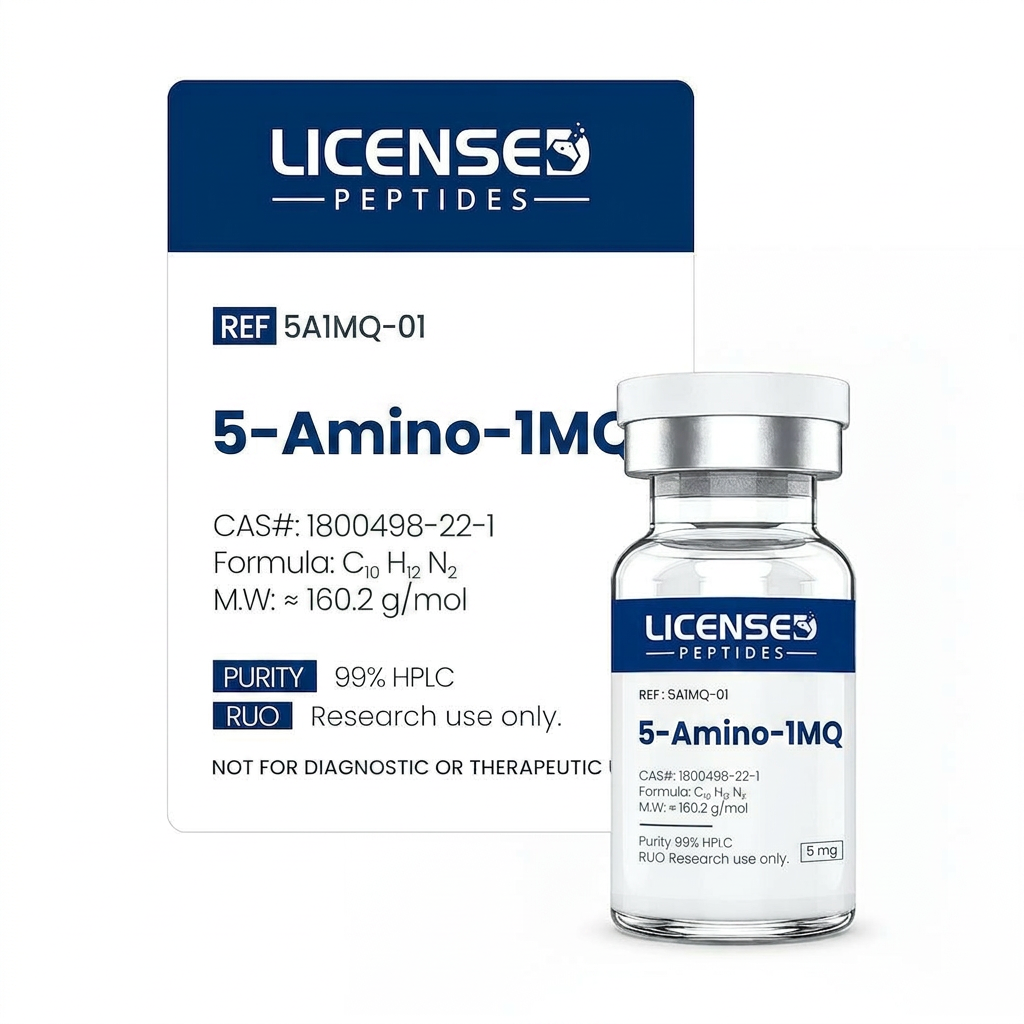
5-Amino-1MQ
- 99%+ HPLC Purity — Independently verified by accredited US laboratory
- Endotoxin-Screened — LAL tested, LPS-free, endotoxin report available
- GMP-Certified Manufacturing — USA facility, ISO 9001:2015
- Lyophilized for Stability — Shipped cold-packed, intact for reconstitution
Add essential supplies:
For laboratory research use only. Not for human or veterinary use.
About 5-Amino-1MQ
5-Amino-1MQ is a high-purity research peptide compound designed for laboratory investigations into metabolic regulation, nicotinamide metabolism, and enzymatic pathways. Supplied as a lyophilized peptide powder with validated purity and endotoxin screening, this compound supports controlled experimental applications. It is for research use only and not intended for human or animal consumption.
Within controlled laboratory environments, researchers study its effects on cellular pathways, including nicotinamide metabolism, NNMT inhibition, and related metabolic signaling mechanisms. Each batch typically undergoes rigorous verification — such as HPLC purity and endotoxin screening — to ensure consistent performance in sensitive research models.
Key Highlights
Quality and specification overview for 5-Amino-1MQ research peptide:
Compound Type
High-purity research peptide derivative.
Manufacturing Standard
GMP-certified lab synthesis, quality tested.
Purity Verification
HPLC confirmed >99% purity (typical).
Endotoxin Tested
LPS-free and endotoxin screened for sensitive research.
Form
Lyophilized peptide powder.
Intended Use
In-vitro and preclinical research only.
Quality Assurance
Verified identity with analytical testing.
Not for Consumption
Not intended for human or animal use.
Potential Research Applications
Research suggests 5-Amino-1MQ may support studies in the following areas. These descriptions are research-oriented and do not imply therapeutic outcomes.
- Metabolic Pathway Modeling — investigating NAD+-related signaling and energy regulation.
- Enzymatic Mechanism Research — exploring how modulation of NNMT impacts biochemical pathways.
- Cellular Function Analysis — assisting laboratory assessments of adipocyte and mitochondrial responses.
- Molecular Biology Investigations — serving as a tool in controlled experimental settings to observe metabolic processes.
How 5-Amino-1MQ Works
In research settings, 5-Amino-1MQ is typically used to explore biochemical mechanisms associated with nicotinamide N-methyltransferase (NNMT) inhibition and cellular energy regulation. By modulating enzymatic pathways such as those linked to NAD+ homeostasis and nicotinamide handling, investigators can examine upstream metabolic processes and cellular responses in controlled experimental models.
Note: This mechanism description refers solely to research models and laboratory observations — not clinical outcomes in humans.
Suggested Research Use & Handling
- Do not use this compound outside approved laboratory settings.
- Ensure all research personnel are trained in chemical handling safety.
In-Vitro Studies
Suitable for controlled tissue and cell culture applications.
Preclinical Research
Useful for non-clinical biochemical pathway investigations.
Handling
Use appropriate PPE (gloves, eyewear) and sterile technique.
Dosing
Prepare in suitable research solvents (e.g., DMSO) per protocol needs.
Storage Instructions
- Store in a cool, dry place away from direct light.
- Keep sealed until ready for use.
- Maintain under specified laboratory conditions to preserve stability.
- Follow institutional safety and storage protocols.
Medical Disclaimer
5-Amino-1MQ is provided only for research and educational purposes. This product is not intended to diagnose, treat, cure, or prevent any disease. Statements about potential mechanisms or experimental outcomes are based on controlled laboratory research, and not on clinical evidence in humans or animals. Always follow institutional ethical guidelines and safety protocols when handling research chemicals.
Frequently Asked Questions
What is 5-Amino-1MQ?
5-Amino-1MQ (5-amino-1-methylquinolinium) is a small-molecule research compound studied as a selective NNMT inhibitor. In published laboratory research it is investigated for its effects on NAD+ metabolism, cellular energy regulation, adipocyte biology, and longevity-related pathways. It is supplied strictly as a metabolic research compound for laboratory and educational use.
- Compound class
- Small-molecule NNMT inhibitor
- Molecular formula
- C₁₀H₁₁N₂⁺ (cation)
- Molecular weight
- ~159.21 g/mol
- Research areas
- NAD+, metabolism, longevity
People Also Ask About 5-Amino-1MQ
Common research questions about 5-Amino-1MQ, NNMT inhibition, and NAD+ metabolism research.
What is 5-Amino-1MQ used for in research?
+
5-Amino-1MQ (5-amino-1-methylquinolinium) is a small-molecule research compound used in laboratory investigations of NNMT (Nicotinamide N-Methyltransferase) inhibition, NAD+ metabolism, cellular energy regulation, and adipocyte biology. It is intended for research-use only.
How does 5-Amino-1MQ inhibit NNMT?
+
In published research, 5-Amino-1MQ acts as a competitive small-molecule inhibitor of NNMT. By occupying the enzyme's active site, it reduces methylation of nicotinamide, which in turn influences the cellular pool of NAD+ precursors available for energy metabolism.
Is 5-Amino-1MQ a peptide?
+
No. 5-Amino-1MQ is a small-molecule quinolinium derivative, not a peptide. It is grouped with research peptides on most supplier catalogs because it is studied in the same metabolic, longevity, and cellular-energy research contexts.
What is the relationship between NNMT and NAD+ metabolism?
+
NNMT consumes nicotinamide and S-adenosyl-methionine (SAM) to produce 1-methylnicotinamide. Because nicotinamide is a salvage-pathway precursor of NAD+, elevated NNMT activity is associated in research with reduced NAD+ availability — which is why NNMT inhibitors such as 5-Amino-1MQ are studied in NAD+ metabolism research.
How is 5-Amino-1MQ stored in a laboratory setting?
+
Lyophilized 5-Amino-1MQ is typically stored cool, dry, and sealed, protected from light and moisture. Reconstituted research solutions are kept refrigerated according to the investigator's protocol. Always follow institutional handling and storage SOPs.
What is the molecular formula of 5-Amino-1MQ?
+
5-Amino-1MQ has the molecular formula C₁₀H₁₁N₂⁺ (cation, commonly supplied as the iodide salt C₁₀H₁₁N₂I). Its molecular weight as the free cation is approximately 159.21 g/mol.
How does 5-Amino-1MQ compare to NAD+ in research applications?
+
NAD+ is a coenzyme directly involved in redox reactions, while 5-Amino-1MQ is an upstream regulator studied for its ability to inhibit NNMT and indirectly influence NAD+ availability. Researchers often study both compounds together to characterize cellular energy and longevity pathways.
About the Author — Licensed Peptides Wholesale Research Team
Reviewed by analytical chemists & research-grade supply specialists
The Licensed Peptides Wholesale Research Team curates educational information on research peptides and small-molecule research compounds, including 5-Amino-1MQ, NNMT inhibitors, and NAD+ metabolism research compounds. Our content is grounded in peer-reviewed literature and supported by third-party HPLC and identity testing for every batch we supply. All product data published here is intended for laboratory and educational research purposes only.
- Third-party HPLC ≥ 99% testing
- Research-grade quality control
- Peer-reviewed source citations
Research References & Scientific Literature
Peer-reviewed publications on NNMT inhibition, NAD+ metabolism, and 5-Amino-1MQ research.
- Neelakantan H. et al. — "Selective and membrane-permeable small molecule inhibitors of nicotinamide N-methyltransferase reverse high fat diet-induced obesity in mice." Biochemical Pharmacology (2018).
- Kraus D. et al. — "Nicotinamide N-methyltransferase knockdown protects against diet-induced obesity." Nature (2014).
- Pissios P. — "Nicotinamide N-Methyltransferase: More Than a Vitamin B3 Clearance Enzyme." Trends in Endocrinology & Metabolism (2017).
- Neelakantan H. et al. — "Structure–Activity Relationship for Small Molecule Inhibitors of Nicotinamide N-Methyltransferase." Journal of Medicinal Chemistry (2017).
- Ulanovskaya O.A. et al. — "NNMT promotes epigenetic remodeling in cancer by creating a metabolic methylation sink." Nature Chemical Biology (2013).
References are provided for educational and research context only. Listing of any publication does not constitute a medical or therapeutic claim about 5-Amino-1MQ.
Related Research Compounds & Guides
Continue exploring NAD+ metabolism, NNMT, and longevity research compounds.
- 5-Amino-1MQ Capsules 50mg
- NAD+ Research Peptide
- MOTS-c Mitochondrial Peptide
- Retatrutide Metabolic Research
- Tirzepatide Research Peptide
- Cagrilintide Research Peptide
- SLU-PP-332 Research Compound
- Bulk 5-Amino-1MQ Offers
- 5-Amino-1MQ Research Guide
- MOTS-c Peptide Explained
- Where to Buy Research Peptides Safely
- Third-Party Testing Library
Related Searches
Long-tail search topics commonly explored alongside 5-Amino-1MQ research.
- 5-Amino-1MQ research compound
- 5-Amino-1MQ NNMT inhibitor for sale
- buy 5-Amino-1MQ research grade
- high purity 5-Amino-1MQ supplier
- NNMT inhibitor research compound
- NAD+ metabolism research compound
- longevity research compounds
- metabolic research compound
- small molecule NNMT inhibitor
- 5-Amino-1MQ vs NAD+
- 5-Amino-1MQ capsules research
- 5-Amino-1MQ HPLC tested
- cellular energy research compound
- mitochondrial research compound
- 1-methylnicotinamide research
Research Use Only. 5-Amino-1MQ is supplied as a research-grade compound for laboratory and educational research only. Information on this page is provided for scientific and educational purposes and is not medical advice.