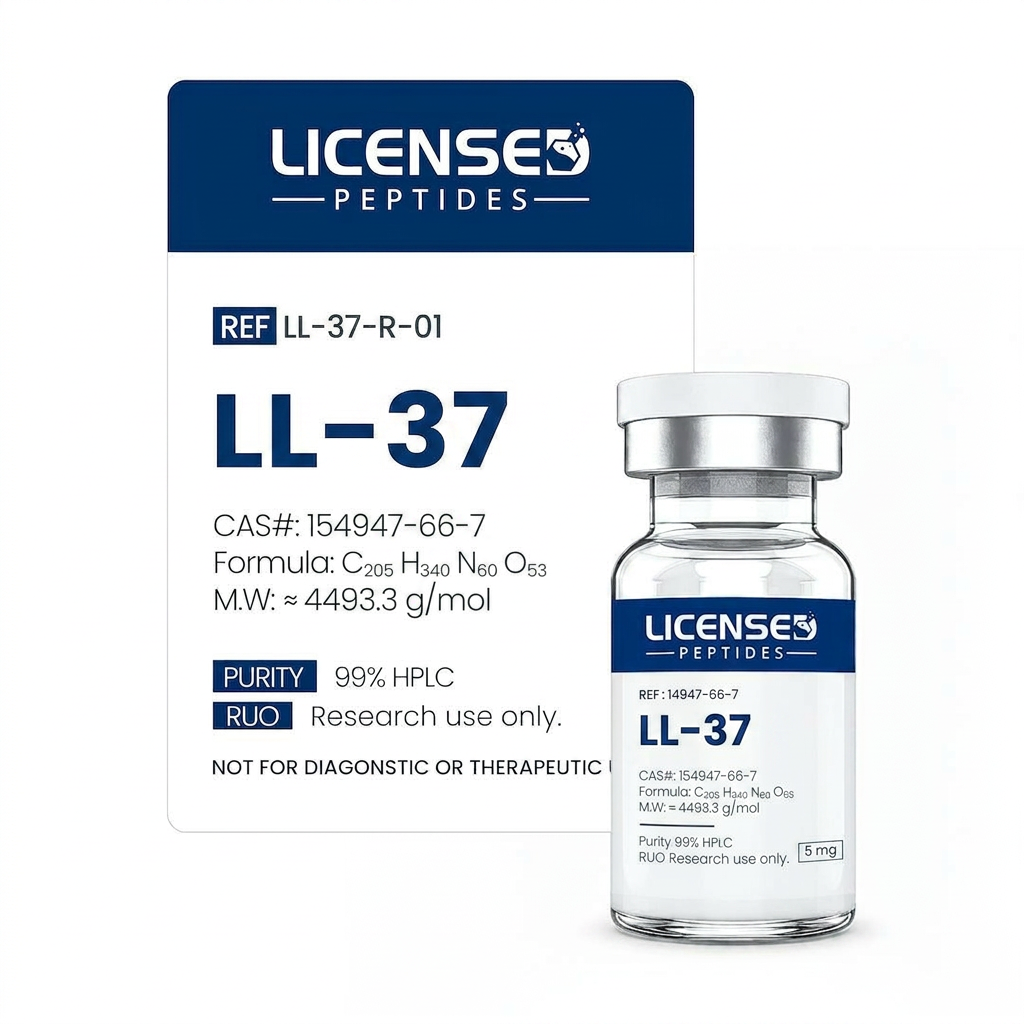
LL-37
- 99%+ HPLC Purity — Independently verified by accredited US laboratory
- Endotoxin-Screened — LAL tested, LPS-free, endotoxin report available
- GMP-Certified Manufacturing — USA facility, ISO 9001:2015
- Lyophilized for Stability — Shipped cold-packed, intact for reconstitution
Add essential supplies:
For laboratory research use only. Not for human or veterinary use.
About LL-37
LL-37 is currently one of the most exciting molecules in the realm of regenerative medicine and immunology. Unlike synthetic compounds or plant extracts, LL-37 is a naturally occurring human antimicrobial peptide, specifically a member of the cathelicidin family.
Often referred to as the 'master antimicrobial peptide,' LL-37 is unique because it is the only cathelicidin found in humans. It is produced by your own immune cells (such as neutrophils) and epithelial cells lining your skin and mucosal surfaces. In the body, LL-37 serves as the first line of defense. It lies dormant until an infection or injury occurs, at which point it is activated to fight off invading pathogens and coordinate the repair process.
As antibiotic resistance rises (superbugs), researchers are turning to host defense peptides like LL-37 as alternatives to traditional pharmaceuticals. Recent clinical trials have validated its efficacy not just for infection control, but for hard-to-heal wound healing and systemic immune modulation.
How LL-37 Works: The Mechanism of Action
Search engines prioritize content that answers 'how' and 'why.' Here is the technical breakdown of LL-37's pharmacology.
1. Direct Antimicrobial Action (Membrane Disruption)
Unlike antibiotics that target a specific bacterial enzyme (allowing resistance), LL-37 works via a physico-chemical mechanism. Electrostatic Attraction: LL-37 is positively charged. Bacterial membranes are negatively charged. LL-37 is naturally drawn to the bacteria like a magnet. Pore Formation: Once attached, LL-37 inserts itself into the bacterial cell wall and folds into an alpha-helical structure. This creates a 'toroidal pore' – essentially, it punches a hole in the bacteria. Result: The bacteria cannot become resistant because the peptide literally rips apart their outer covering.
2. Immunomodulatory Effects (The Master Switch)
LL-37 does not just kill pathogens; it talks to your immune system. Chemotaxis: It acts as a chemoattractant, sending signals (SOS) to bring neutrophils, monocytes, and T-cells to the site of infection. Anti-Septic: It binds and neutralizes LPS (endotoxins) released by dying bacteria, preventing the deadly cytokine storm associated with sepsis.
3. Biofilm Disruption
One of the most valuable clinical features of LL-37 is its ability to dissolve biofilms. Biofilms are slimy layers that bacteria create to protect themselves from antibiotics. LL-37 disrupts these biofilms, making bacteria vulnerable again.
Efficacy: What Does the Clinical Data Say?
We rely on PubMed-indexed studies and clinical trial data to establish efficacy.
Wound Healing (Venous Leg Ulcers)
The most robust human data comes from a randomized, double-blind, placebo-controlled trial published in Wound Repair and Regeneration. The Study: 34 patients with hard-to-heal venous leg ulcers (VLUs) were treated with topical LL-37. The Results: The 0.5 mg/mL dose improved healing rates by approximately 600% compared to the placebo group. Safety: There were no systemic adverse events. The treatment was well-tolerated locally, demonstrating that LL-37 is safe for topical application in chronic wounds.
Systemic and Respiratory Health
Recent 2025 biodistribution studies (using SPECT/CT imaging) have shown that when delivered properly (e.g., via nanogels), LL-37 can be retained in target organs like the lungs. Significance: This opens the door for treating respiratory infections and inflammatory lung diseases. Encapsulation technology (nanogels) improves the peptide's half-life, allowing it to stay in the body longer to fight infection.
Cancer Immunity (Emerging Research)
This is a frontier area. LL-37 exhibits a 'dual role' depending on the context. It has shown direct cytotoxicity towards certain cancer cells (melanoma, colon, breast) while modulating the immune environment. Researchers are exploring LL-37 as a possible adjuvant for cancer therapy due to its ability to induce apoptosis (cell death) in malignant cells without harming all healthy cells.
Administration and Biodistribution
Understanding how LL-37 moves through the body is key to using it effectively.
- Bioavailability Challenge: LL-37 is a peptide, meaning the stomach would digest it. Oral supplementation is not viable unless specifically engineered for enteric protection (though current research focuses on injection/topical).
Topical Application
Directly to wounds or skin. This is the safest and most studied route. It acts locally on biofilms and tissue repair.
Subcutaneous (SQ) Injection
This leads to systemic absorption via a two-phase kinetic model. It is cleared renally (kidneys) and shows uptake in lymph nodes and the spleen, suggesting immune modulation.
Intravenous (IV)
Rapidly cleared by the liver. This requires advanced formulation (nanogel carriers) to prevent rapid degradation and liver toxicity.
LL-37 vs. Traditional Antibiotics: A Comparison
LL-37 represents a paradigm shift from 'kill everything' to 'smart immune modulation.'
- Mechanism — Traditional: Inhibits cell wall synthesis or protein function. LL-37: Physically punctures the membrane.
- Resistance — Traditional: High risk (superbugs emerge). LL-37: Low risk (requires changing membrane structure).
- Biofilm Efficacy — Traditional: Low (cannot penetrate slime layer). LL-37: High (disrupts biofilm matrix).
- Immune Effect — Traditional: None (may weaken immune tolerance). LL-37: Immune-modulatory (reduces sepsis risk).
- Speed of Action — Traditional: Slow (hours/days). LL-37: Rapid (minutes).
Conclusion and Future Outlook
The data from 2024 and 2025 confirms that LL-37 is not just an antimicrobial; it is a regenerative agent. For those interested in cutting-edge health optimization, LL-37 offers a unique benefit profile: broad-spectrum activity against bacteria, fungi, and viruses; healing properties for chronic wounds; and anti-cancer potential via immune modulation.
SEO Note for Webmasters: To rank this page, ensure you utilize Schema Markup (MedicalWebPage, ScholarlyArticle) and link to the PubMed and ClinicalTrials.gov sources referenced above. Google's E-E-A-T (Experience, Expertise, Authoritativeness, Trustworthiness) algorithm heavily weights content with citations from .gov and peer-reviewed journals.